
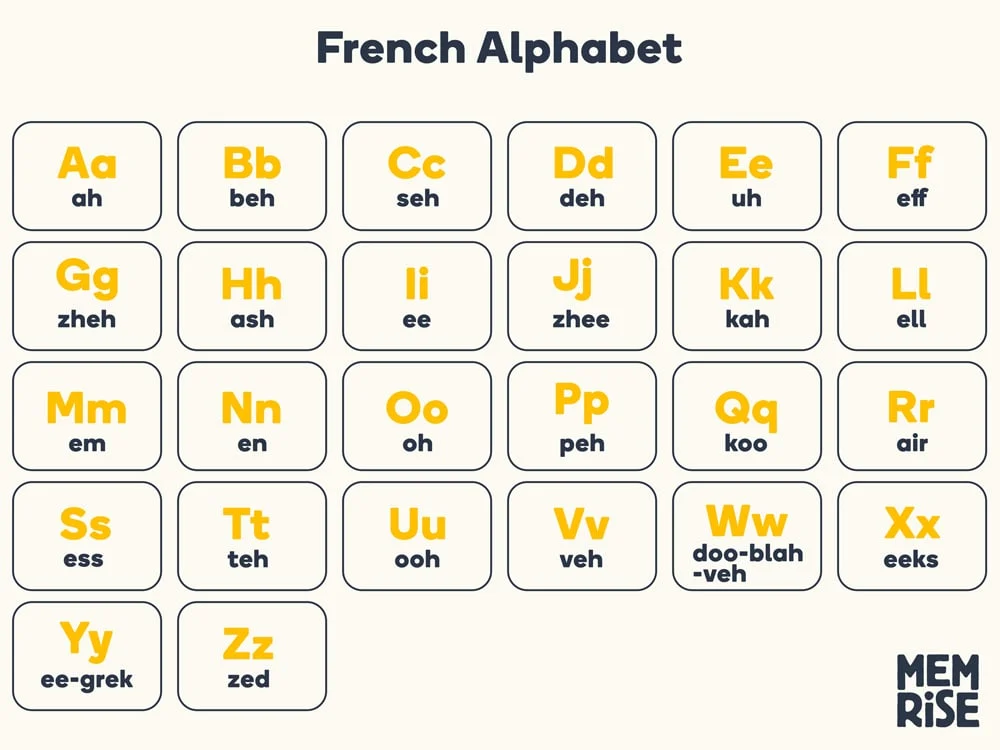

Vowels
Letters and combinations Pronunciation Examples and Tips
a, à, â (ah) sa, la, pâte
ai (ay) j’ai, mais
eau, au ,aux (oh) eau,auto, jaune , aux , bateaux
é,er,ez ,es ,et (closed e) (ay) pré , parler ,parlez , mes, et
è,ê,e followed by double consonants and -et (open e) (eh) chèvre , tête , belle , appelle , effet
e in one-syllable words,and in eu, œu (œufs) (uh) le,que, de ,peu ,œufs, bleu
To say the sound (uh) ,hold your tongue as if to make the (ay) sound and round your lips as if to make the (oh) sound.
eur,œu,œur (ERR) chanteur,leur ,sœur,œuf , œuvre, heure
when followed by r or another sounded consonant , this is a more “open” version of the sound (uh)
i, î , and y as a pronoun (ee) cri, fil, ils, île, il y a
ill(with double ll) (eel) pronounced (eel) only in ville, village, mille, million and tranquille. Otherwise the ill combinations contains a semi-vowel.
Final o,o before s , and ô (closed o ) (oh) vélo , zoo, roses, hôtel, môme
o before constants (not s (open o ) (uh) bonne, monnaie, homme ou, où, oû (oo) sou, où, goûtez , foule
or (uhR) port, accord, sorbet ,ordre
u (single u), û (U) tu,rue,jupe,flûte
To pronouce (U), hold your tongue as if to make the (ee) sound ,and round your lips as if to make the (oh ) sound
Semi-vowels
ill,ail,eil (eey),(ahy)(ayy) fille ,famille ,travail , Marseille
ie,i , and y ( not final) (y) bien , science ,voyage ,nation , croyez
oi,ua (wah) moi,quoi , revoir ,fois , guano
oui (wee) oui
ui,ue,ua (Uee)( Uay) (Uah) huit,fruit,muet,suave
This semi-vowel contains the singe u sound (U)
Nasal Vowels
French has several “nasalized” vowels,spelled with the letter conbinations a,e,i,y,o plus the letters n or m (,examples: flan,montagne,lent)
Pronounce the nasal vowels as a single sound through your mouth and nose at the same time.
The letters n or m are not pronouced in a nasal conbination . But they are pronounced when immediately followed by a vowel(examples : fine, guano ) or when the n or *m*is doubled (examples: homme, bonne).
an, am, en,em (An) dans , lampe, trente, exemple
en, in, un, ym, Im ,yn, ain, ain, aim, ein (In) bien, matin ,vingt , un, sympathique, train ,faim, plein
on,on (On) bonbon ,son,combien,fondation*
Consonants
Many French consonant sounds (for example : b,e,d,f,k,l,m,n,p,t,,v,z) closely resemble their English counterparts.
Pronounce the consonants forward in your mouth ,and always try to avoid making plosive sounds (puff of air),particularly with b,p , and t.
Here are several consonants sounds specific to French. Some variants are the same as in English (for example, “hard” c (k) “hard” g(g),and qu(k).
Sounds not listed here are pronounced nearly like English.
C,cc before a,o, u or a consonant (k) court, chacun, accord, classe
c before I, e, y and the letter ç (s) merci, cercle, cyclisme, François
Ch (sh) chose, machine
g before a,o,u or a consonant (g) glace, gare
g before e,i,y (zh ) Georges, gigot
J(zh ) bonjour, jour, jardin
gn (ny)montagne,peigner,
h. __. The letter h is always silent in French. Some words starting with h don’t elide articles or pronouns (examples : le héros, le hasard
qu,q (k) quelquefois ,cinq
r,rr (R). riche,bizarre, original The French r (as in bonjour, Robert) is normally probounced at the back of the throat, with a slight gargling sound
s, initial or double s, t in – tion final x (s) salut,fausse, nation, six, dix
s between two vowels or in -sion (z) mademoiselle , excursion
th (t) Thomas, Thé
The English “lisp” th does not exist in French.
X before a consonant (ehks) excellent, expression
x before a vowel (ehg) examen,exemple
Pronunciation Tips
• When you speak , remember to keep vowel sounds and all syllables short and clear.
• Syllabus in French are considered part of an utterance , not part of a word. Syllables start with a consonant : les _idées (lay-zee-day),vous_allez (voo-zah-lay). Words in a phrase and successive words in a sentence are usually linked.
• French sounds , except for the “gargled” sound of r (R),are farther forward in the mouth than English.
• There is a slight “fall” or descending intonation on the last word of a sentence or syllable of a word.
• In yes/no questions, intonation rises slightly (tu arrives?). It tends to fall slightly at the end of information questions (comment allez-vous ?).